B2B marketers face a familiar challenge: generate a steady pipeline of new opportunities while building real relationships with accounts that move the revenue needle. Account-based marketing and traditional lead generation tackle these goals from different angles.
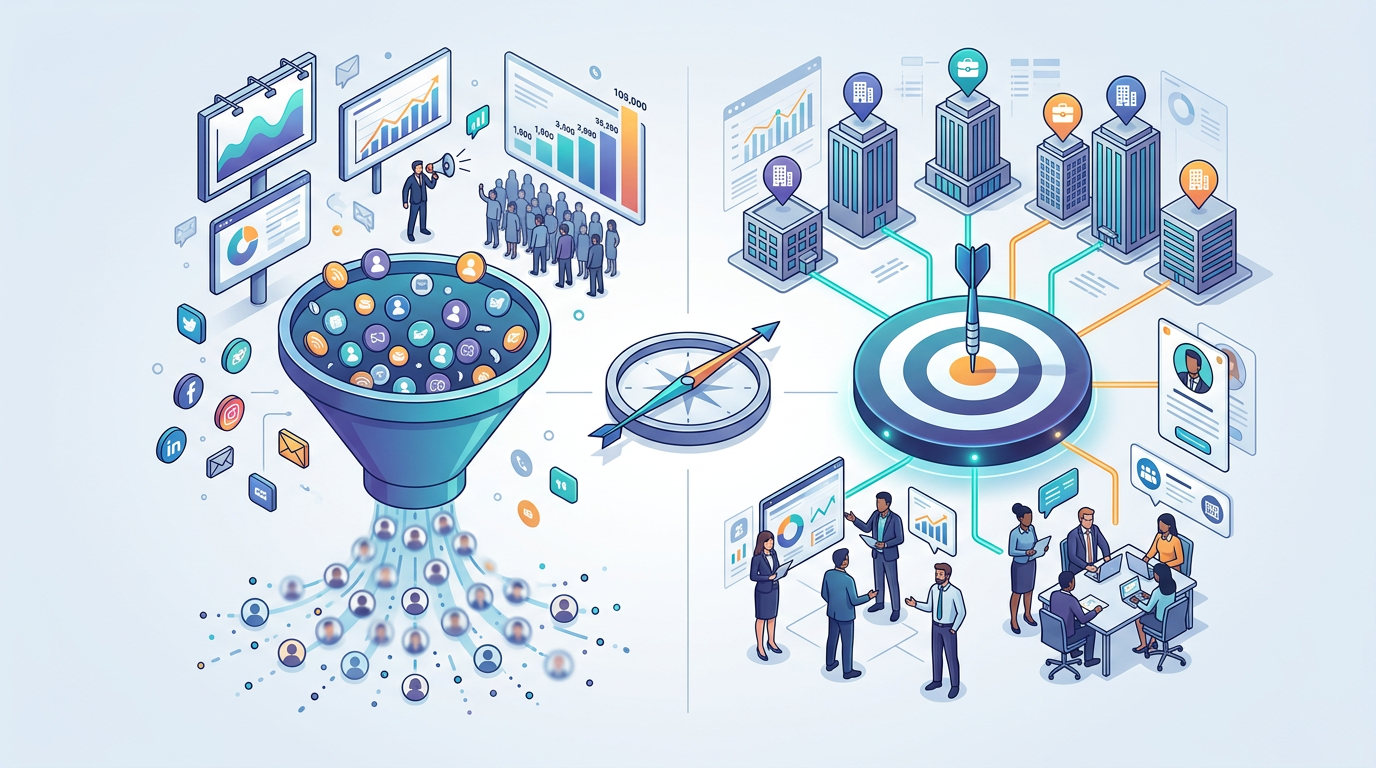
ABM focuses your marketing and sales efforts on a shortlist of high-value accounts. Traditional lead generation, by contrast, aims to attract a broader pool of individual prospects through channels like content, search, paid media, and events. There’s no universal winner here. The best approach depends on your market, deal size, sales process, data maturity, and growth targets.
What Is Account-Based Marketing?
Account-based marketing is a focused B2B strategy that treats each target company or segment as its own market. Instead of chasing a high volume of leads and sorting them out later, teams pinpoint organizations that fit their ideal customer profile and build engagement specifically for those accounts.
An ideal customer profile, or ICP, defines the characteristics of businesses most likely to gain value from your solution and become successful customers. (What Is an Ideal Customer Profile (ICP)? B2B Examples, 2026) It may include factors such as:
- Industry and company size
- Annual revenue or funding stage
- Geographic market
- Technology stack
- Business challenges or priorities
- Buying triggers, such as growth, hiring, expansion, or a technology change
- Potential customer lifetime value
After you identify your target accounts, marketing and sales need to map the full buying committee. In complex B2B deals, that often means engaging everyone from executive sponsors and daily users to finance, IT, procurement, and legal. (What are B2B Buying Groups? How to Engage Every Stakeholder, 2026) ABM acknowledges that a single form fill rarely captures the real decision-making process. (Severini et al., 2026, pp. 148-161)
Common ABM Tactics
ABM can range from highly personalized outreach for a few strategic accounts to more scalable programs for hundreds of similar companies. Common tactics include:
- Personalized landing pages and account-specific content
- Targeted LinkedIn, display, and connected-TV advertising
- Sales outreach informed by account engagement and intent signals
- Executive events, webinars, roundtables, or direct-mail campaigns
- Industry-specific case studies and solution pages
- Email nurture programs tailored to account challenges
- Website experiences customized by industry, company size, or account status
The key is alignment. Sales and marketing must agree on which accounts to prioritize, what messages will resonate, who needs to be involved, and how you’ll measure progress. (Sales and Marketing Alignment in ABM: One List, One Message, One Play, 2026)
What Is Traditional Lead Generation?
Traditional lead generation takes a wide-angle approach: attract, capture, nurture, and qualify individual prospects at scale. The process starts by building demand across a broad audience, then zeroing in on those who signal interest—whether that’s downloading a guide, signing up for a webinar, or requesting a demo.
The approach often follows a familiar funnel:
- Attract: Reach potential buyers through SEO, content, paid media, social media, events, referrals, and outbound prospecting.
- Capture: Offer a valuable next step, such as a newsletter, template, guide, webinar, consultation, or demo.
- Nurture: Provide relevant content and follow-up through email, retargeting, sales development, or automation.
- Qualify: Determine whether a lead fits the target audience, has meaningful interest, and is ready for sales engagement.
- Convert: Move qualified prospects into opportunities, customers, and ideally advocates.
Traditional lead generation doesn’t have to be generic. With smart segmentation and behavioral triggers, you can make nurture programs highly relevant. The key difference is that you start with a broad audience or individual prospects, not a set list of target accounts. (ABM vs Lead Generation: Which Should You Choose?, 2026)
Common Lead-Generation Tactics
- Search engine optimization and educational blog content
- Paid search and paid social campaigns
- Downloadable guides, templates, or reports
- Webinars, virtual events, and live demonstrations
- Email newsletters and automated nurture sequences
- Website forms, chat, and consultation offers
- Social media content and community engagement
- Outbound email and prospecting campaigns
This approach works best when your addressable market is wide, your solution has a shorter evaluation cycle, or you need to build awareness before buyers even realize they have a need. (Account-Based Marketing vs Traditional Lead Generation: What SMBs Need to Know, 2025)
ABM and Lead Generation Compared
| Area | Account-Based Marketing | Traditional Lead Generation |
| Primary audience | Selected high-value companies and buying committees | A broader audience of individual prospects |
| Starting point | A defined account list and ideal customer profile | A broad market, campaign audience, or topic |
| Personalization | Often account-, industry-, or role-specific | Usually segmented by persona, behavior, or lifecycle stage |
| Main goal | Create and advance opportunities within priority accounts | Generate, capture, and qualify leads at scale |
| Sales cycle | Often longer and more complex | Often shorter or more standardized, though not always |
| Content strategy | Tailored to specific account needs, industries, or buying roles | Built around common questions, pain points, and search demand |
| Common channels | LinkedIn, account-targeted ads, direct outreach, events, personalized email | SEO, paid search, content, webinars, email, forms, paid social |
| Sales and marketing alignment | Essential from the beginning | Important, but often more sequential through lead handoff |
| Measurement | Account engagement, buying-group reach, pipeline, opportunity progression, revenue | Lead volume, cost per lead, conversion rate, MQLs, pipeline, revenue |
| Scalability | More resource-intensive at the highest personalization level | Generally easier to scale reach and lead volume |
| Best fit | High-value, strategic, complex B2B opportunities | Broad markets, ongoing demand generation, and scalable awareness building |
Where ABM Wins
ABM shines when a handful of accounts can make a real difference to your bottom line. If your deals are large, the sales cycle is complex, and trust matters, deep engagement with the right accounts delivers more value than chasing a long list of lightly qualified leads.
High-Value Deals
When one closed account can justify substantial marketing and sales investment, an account-focused model makes practical sense. A company selling enterprise software, specialized consulting, industrial equipment, cybersecurity services, or complex technology solutions may need only a limited number of well-qualified opportunities to meet its revenue goals.
In these scenarios, treating every prospect equally spreads your resources too thin. ABM lets you double down on the accounts that truly fit your strategy.
Complex Buying Committees
B2B purchases frequently involve more than one decision-maker. (B2B Buying Committee Benchmarks, 2026) A traditional lead model may identify one interested person but miss the budget holder, technical evaluator, executive sponsor, or procurement team. (Account-Based Marketing: How It Actually Works (and Where ABM Programs Break), 2026)
ABM pushes teams to map out the entire buying group. This approach improves message relevance, reduces the risk of relying on a single contact, and helps sales build organizational consensus. (Patterson, 2022)
Long Sales Cycles
When sales cycles are long and complex, persistence and relevance are critical. ABM makes it easier to deliver valuable information over time through targeted content, sales outreach, advertising, and events, without forcing every interaction into a lead-conversion moment. (Account-Based Marketing (ABM): definition, workflow, roles, metrics & SOP, 2026)
Strategic Named Accounts
Some accounts are strategic because of their revenue potential, influence, partnership value, or brand credibility. (Geiger & Naacke, 2022, pp. 751-773) If you have a clear list of companies you want to win, ABM gives you the structure to focus on what matters most.
Where Traditional Lead Generation Wins
Traditional lead generation often fits right when you need broad reach, steady inbound interest, and a repeatable process to turn demand into sales conversations.
Broad Markets
If your solution could help thousands of companies or consumers, narrowing your focus to a small account list can limit your growth. (Mathis, 2023) Tactics like SEO, educational content, paid search, and social media help you reach buyers who are already searching for answers.
This matters most when buyers don’t know your brand or even know your solution category exists.
Shorter Sales Cycles
For lower-priced products, standardized services, or self-serve software, it’s often more efficient to generate and qualify a higher volume of leads. (Lead Generation Statistics 2026, 2026) The aim is to make it simple for interested buyers to move quickly from discovery to purchase.
Brand and Category Building
If you’re building a new brand, you need awareness before you can expect real account-level engagement. (Rashbass, 2024) Content marketing, organic search, webinars, social media, and paid campaigns help establish credibility, answer buyer questions, and generate demand.
Consistent Inbound Demand
A strong lead-generation engine delivers steady traffic, subscribers, and qualified inquiries. (Rigby, 2026) This gives your sales team a consistent flow of interested prospects, especially when supported by valuable content and timely follow-up. (Unpacking account-based marketing: Conceptualization, key activities, and performance outcomes, 2026, pp. 148-161)
A Hybrid Strategy Is Often Strongest
In practice, the most effective strategy rarely relies solely on ABM or traditional lead generation. The real advantage comes from combining both in a coordinated way. (Mathis, 2023) To make a hybrid approach work in daily operations, align your teams in practical ways: share account and lead data across platforms, coordinate campaign calendars so outreach stays consistent, and hold regular sales-and-marketing meetings to review results together. This alignment keeps you from missing opportunities—you can route high-intent leads from broad campaigns quickly to ABM playbooks, and insights from targeted accounts can inform broader demand generation. Simple steps like joint dashboards, shared qualification criteria, and routine team syncs help bring ABM and lead generation together for smoother execution. (ABM Sales and Marketing Alignment: The Framework That Actually Works, 2026)
Broad demand generation builds awareness and captures interest across your market. ABM then lets you focus extra attention on the accounts that match your ICP or show strong buying signals.
For example, a B2B software company could use:
- SEO to rank for high-intent questions and solution comparisons
- Paid search to reach buyers actively researching relevant terms
- Educational content to help prospects understand a business problem
- LinkedIn campaigns to build awareness among relevant roles and industries
- Marketing automation to identify repeat visits, content engagement, and demo interest
- ABM advertising and personalized outreach for target accounts showing strong signals
- Sales outreach that references the account’s industry, current priorities, and likely use cases
In this model, traditional lead generation fuels your demand engine, while ABM increases relevance and alignment for the accounts that matter most. (Mathis, 2023)
How to Choose the Right Approach
Ask yourself these questions to determine which approach makes the most sense for your business right now.
Choose ABM First If:
- Your average deal value is high.
- Your sales cycle is long or complex.
- Multiple stakeholders influence the purchase.
- You have a well-defined ideal customer profile.
- Your team has a manageable list of high-priority accounts.
- Sales can actively follow up and personalize outreach.
- Winning a small number of accounts would materially affect revenue.
Choose Traditional Lead Generation First If:
- Your market is broad and varied.
- You need to build awareness and attract new demand.
- Your offering is easier to understand or purchase.
- You have a shorter sales cycle.
- You need consistent inbound traffic and a steady flow of leads.
- Your website, content, and search presence need strengthening.
- Your sales process can qualify more inquiries efficiently.
Use a Hybrid Model If:
- You need both near-term pipeline and long-term market visibility.
- You serve multiple segments with different deal sizes or sales cycles.
- You have strategic accounts but also want scalable inbound growth.
- Your sales and marketing teams can share data and coordinate priorities.
- You want to use engagement signals to decide where to personalize further.
Metrics That Matter
Your metrics should track how your business actually grows, not just how many people see or click on a campaign.
Traditional Lead-Generation Metrics
- Traffic: The number of website visits and where they come from.
- Lead volume: The number of contacts who take a conversion action.
- Cost per lead: The marketing cost required to generate each lead.
- Landing-page conversion rate: The percentage of visitors who complete a desired action.
- Marketing-qualified leads: Leads that meet defined fit and engagement criteria.
- Sales-qualified leads: Leads that sales agrees are ready to engage directly.
- Opportunity creation: The number of qualified leads that become active sales opportunities.
- Customer acquisition cost: The total cost of acquiring a new customer.
ABM Metrics
- Account engagement: Meaningful activity from contacts at target accounts.
- Buying-group coverage: The number of relevant stakeholders engaged within an account.
- Account progression: Movement from awareness to engagement, opportunity, and closed business.
- Pipeline velocity: How efficiently opportunities move through the sales process.
- Opportunity creation: New opportunities created within target accounts.
- Average deal size: Revenue potential or closed revenue per customer.
- Win rate: The percentage of opportunities that become customers.
- Revenue influence: The contribution marketing activity makes to pipeline and closed revenue.
A strong measurement framework tracks both leading indicators like engagement and conversion rates, and business outcomes like pipeline quality, revenue, and customer retention. (ABM Strategy for Pipeline Growth: How Account-Based Marketing Builds Qualified Pipeline, 2026)
Getting Started
No matter which approach you choose ABM, traditional lead generation, or a hybrid start with a focused plan, not a massive rollout.
- Align sales and marketing. Agree on revenue goals, target audiences, definitions of qualified opportunities, ownership, follow-up expectations, and reporting.
- Define your audience. Build an ICP for ABM, buyer personas for lead generation, or both for a hybrid model.
- Audit your current data. Review CRM records, website analytics, campaign performance, customer interviews, and sales feedback to identify patterns.
- Pick a handful of KPIs that tie directly to your program’s main goal, and track those closely. For added clarity, here are example KPIs for each approach: For ABM, you might measure account engagement (e.g., the number of meaningful interactions with target accounts) or buying-group coverage (e.g., the number of relevant stakeholders reached within an account). For traditional lead generation, consider tracking lead volume (qualified leads generated) or landing-page conversion rate (the percentage of website visitors who complete a desired action). Align your metrics with what best shows real progress toward your goals.
- Create useful content. Match your content to buyer questions, industry challenges, and evaluation stages.
- Run a limited test. Start with a small account list, a focused campaign, or one audience segment. For example, a B2B SaaS company looking to test ABM selected five target accounts from its CRM that closely matched its ideal profile. The team developed personalized email outreach, created custom landing pages for each account, and coordinated follow-up between marketing and sales. Within two months, this pilot generated meetings with three of the five companies and surfaced valuable feedback on messaging and needs. Even a simple pilot like this can reveal which tactics resonate and where to iterate before scaling your approach. (Mathis, 2023)
- Review and refine as you go. Use performance data and sales feedback to sharpen your targeting, messaging, channels, and follow-up before scaling up.
The Winning Strategy Is the One That Fits Your Business
ABM and traditional lead generation each address different sides of the B2B growth equation. ABM lets you go deep with high-value accounts, complex buying groups, and strategic opportunities. Traditional lead generation helps you build awareness, reach a wider market, and create a scalable pipeline of new demand.
The best strategy aligns with your business model and revenue goals. Suppose your growth hinges on winning a few complex, high-value customers; ABM is likely worth a bigger investment. If you need broader visibility and a steady stream of new interest, traditional lead generation is often the right place to start.
For many B2B teams, the real opportunity is in combining both approaches: build broad demand across your market, then use account-level insight and personalized engagement to turn the right opportunities into pipeline.
Take a hard look at your current demand-generation strategy. Where would a more targeted account approach or a stronger, scalable lead engine make the biggest difference to your pipeline?
Next-Step Checklist: Evolve Your Demand Generation Strategy
1. Review your current revenue goals and target segments.
2. Assess your sales cycle: Is it long and complex, or short and transactional?
3. Outline your ideal customer profile and main buyer personas.
4. Map your existing lead sources and account list. Identify any gaps.
5. Analyze your pipeline metrics: Where are the biggest drop-offs or bottlenecks?
6. Evaluate sales and marketing alignment around target accounts and lead follow-up.
7. Audit your content: Does it address key buyer questions at each stage?
8. Choose top priorities for improvement—ABM, lead generation, or a hybrid approach.
9. Set clear KPIs tied to business results, not just activity.
10. Plan a pilot: Test an ABM play for 3-5 top accounts, or a targeted lead-generation campaign.
11. Monitor results, collect feedback, and iterate based on what works.
Use this checklist to turn insight into action. Small, focused changes can measurably improve your pipeline.
References
(2026). What Is an Ideal Customer Profile (ICP)? B2B Examples. SalesOne.
(2026). What are B2B Buying Groups? How to Engage Every Stakeholder. Demandbase.
Severini, S., Terho, H., & Mero, J. (2026). Unpacking account-based marketing: Conceptualization, key activities, and performance outcomes. Industrial Marketing Management, 133, pp. 148-161.
(2026). Sales and Marketing Alignment in ABM: One List, One Message, One Play. Marc Roelofs.
(2026). ABM vs Lead Generation: Which Should You Choose?. Hatchlee.
(2025). Account-Based Marketing vs Traditional Lead Generation: What SMBs Need to Know. SimpleABM.
(2026). B2B Buying Committee Benchmarks. The Starr Conspiracy.
(2026). Account-Based Marketing: How It Actually Works (and Where ABM Programs Break). Datalane Blog.
Patterson, C. (2022). Buying group marketing: The next evolution of ABM.MarTech.org.
(2026). Account-Based Marketing (ABM): definition, workflow, roles, metrics & SOP. B2BProcess.
Geiger, I., & Naacke, D. (2022). “What’s it really worth?” A meta-analysis of customer-perceived relationship value in B2B markets. Journal of Business & Industrial Marketing, 38(4), pp. 751-773.
Mathis, S. (2023). Account-Based Marketing vs. Lead Generation, Explained. TechTarget.
(2026). Lead Generation Statistics 2026. Gigde.
Rashbass, H. (September 5, 2024). Brand has ‘never been more important in B2B marketing’, research reveals—Marketing Week.
Rigby, K. (2026). 120+ Lead Generation Stats Backed by Our Own Data & Research. Ruler Analytics.
(2026). Unpacking account-based marketing: Conceptualization, key activities, and performance outcomes. Industrial Marketing Management 133, pp. 148-161.
Mathis, S. (2023). Account-Based Marketing vs. Lead Generation, Explained. TechTarget.
(2026). ABM Sales and Marketing Alignment: The Framework That Actually Works. GTME Blog.
Mathis, S. (2023). Account-Based Marketing vs. Lead Generation, Explained.TechTarget.
(2026). ABM Strategy for Pipeline Growth: How Account-Based Marketing Builds Qualified Pipeline. Rox.
Mathis, S. (2023). Account-Based Marketing vs. Lead Generation, Explained. TechTarget.
No responses yet