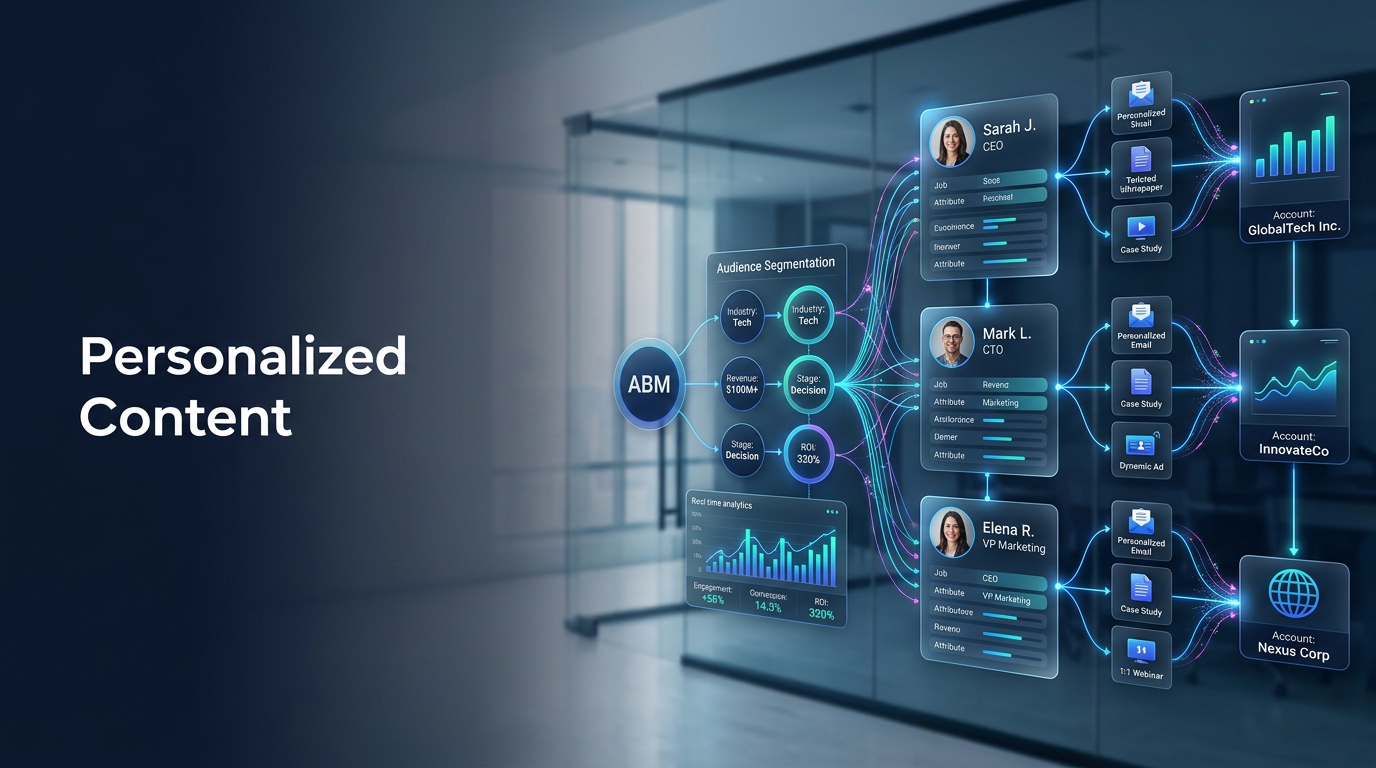
If you’re a B2B marketer, you know that turning account intelligence and buyer insights into real engagement—and actual pipeline growth—takes more than just good content. It’s about connecting the dots between what you know about your target accounts and the strategic content that moves them to action.
Account-Based Marketing (ABM) has flipped the script on B2B customer acquisition. Instead of blasting out broad campaigns and hoping the right people bite, ABM zeroes in on a shortlist of high-value accounts. The goal is simple: deliver content and experiences that speak directly to each organization’s real business challenges, priorities, and buying motivations.
Content is the engine that drives successful ABM.
But real ABM personalization isn’t just swapping in a company name or dropping a logo onto a landing page. It means digging into what actually matters to each account—their business goals, industry pain points, tech stack, competitive landscape, and the decision-makers who call the shots.
For B2B marketers, that shift means leaving behind generic messaging and building content that proves you understand the account’s world—and gives them a clear reason to engage.
Personalizing ABM content isn’t just a creative task—it’s a strategic process. It brings together data intelligence, audience research, smart content development, the right martech, and ongoing optimization.
In this article, we’ll break down how to build that process, the tools that make it work, and real-world examples of account-based personalization in action.
1. Understanding the Role of Personalization in ABM
Traditional demand generation typically emphasizes attracting as many qualified leads as possible through broad campaigns, keyword targeting, and audience segmentation.
ABM flips that approach on its head.
Marketing and sales teams identify the organizations most likely to become valuable customers, research their business needs, and develop coordinated campaigns designed to engage multiple stakeholders within those accounts.
This distinction is important because enterprise purchasing decisions rarely involve just one person.
A buying committee may include:
- C-suite executives evaluating strategic value and business risk.
- IT leaders assessing technical compatibility, security, and implementation.
- Department heads evaluating operational improvements.
- Finance teams examining costs, ROI, and budget implications.
- Procurement teams negotiating contracts and vendor requirements.
- End users assessing usability and practical benefits.
Each stakeholder has different priorities, concerns, and definitions of success.
A generic marketing message about improving operational efficiency may attract attention, but it is unlikely to persuade every member of a buying committee.
A smarter approach is to build distinct content experiences for each stakeholder, all tied to the same core business opportunity.
For example, a SaaS company selling marketing automation software might develop:
Here’s how content can vary based on each stakeholder’s perspective:
– Executive brief: Outlines how the solution supports the company’s top-line business goals, offers strategic ROI projections, and addresses the risks and competitive advantages that concern the C-suite.
– Technical guide: Goes in-depth on product integration, security features, technical requirements, and how the solution fits with existing technologies for IT leadership.
– Department overview: Explains improvements to day-to-day operations, reporting functionality, and end-user productivity for department heads or line-of-business leaders.
– Financial analysis: Breaks down cost savings, pricing models, and long-term value for finance stakeholders.
– Implementation roadmap: Shows key steps, onboarding resources, and potential quick wins to reassure procurement, operations, and end users.
By tailoring content like this, marketers ensure each stakeholder sees messaging and evidence that speaks directly to their role and business priorities. The product doesn’t change—the business case does, depending on who you’re talking to.
That’s the foundation of effective ABM content: giving the right people the right information, in the context of what matters most to their business.
LinkedIn’s ABM guidance identifies account research, tailored content development, campaign execution, and measurement as core stages of an effective program. It also emphasizes collaboration with sales and customer success teams to identify the objections and questions that content should address.
2. Start With Account Intelligence, Not Content Production
A common ABM misstep? Jumping straight into content planning before you’ve done the account research.
Before you start building personalized campaigns, you need to really understand the organizations you’re targeting.
Account intelligence is your foundation for real personalization. It helps you see the gap between what a company says it wants and what its situation actually calls for.
A comprehensive account research process should examine several areas.
Firmographic data
Identify company size, annual revenue, industry, geographic footprint, employee count, and organizational structure. These details help determine whether an account fits the ideal customer profile (ICP).
Technographic data
Understand which technologies the organization currently uses. Existing CRM platforms, marketing automation systems, analytics tools, cloud infrastructure, and other applications can reveal integration requirements and potential opportunities.
Intent data
Look for evidence that an organization is actively researching solutions. Topic consumption, relevant website activity, third-party research signals, and engagement with competitor-related content can help identify accounts entering a buying cycle.
Intent data should be treated as an indicator of interest rather than definitive proof of purchase intent.
Business and organizational signals
Monitor company announcements, executive appointments, mergers and acquisitions, expansion plans, funding announcements, product launches, and hiring activity.
These signals can uncover timely opportunities to connect your solution to a pressing business need.
For example, a company expanding into international markets may suddenly need better marketing automation, localization, analytics, or customer data management capabilities.
Instead of blasting out a generic software promo, your team could build content that shows exactly how your solution supports international expansion, multilingual campaigns, and cross-market reporting.
Competitive intelligence
Understand the organization’s competitive environment. Identify market pressures, industry challenges, and potential weaknesses in existing approaches.
The goal isn’t to guess at a prospect’s pain points. It’s to form smart, data-backed hypotheses you can test through sales conversations and engagement signals.
Turning account intelligence into content opportunities
Consider a hypothetical enterprise software company targeting a financial services organization.
Research reveals that the prospect has recently expanded its digital services, is hiring cybersecurity specialists, and has several legacy systems.
Those signals suggest several potential content opportunities:
- A technical guide addressing integration with legacy infrastructure.
- A security and compliance briefing for IT leadership.
- An executive report examining digital transformation and operational efficiency.
- A financial analysis demonstrating potential cost savings.
- A customer success story featuring a similar financial services organization.
Each piece of content tackles a different stakeholder concern, but all support the same sales opportunity.
The result? A coordinated content strategy—not just a pile of disconnected marketing assets.
3. Develop a Personalized Content Strategy Around the Buying Committee
Once you’ve nailed down your account intelligence, the next step is figuring out what content each stakeholder needs—and when.
Your ABM content should match both the buyer’s role and where the account is in their purchase journey.
A useful framework divides content development into three levels.
One-to-many: Industry and segment personalization
One-to-many ABM targets groups of accounts sharing similar characteristics.
Examples include:
- Healthcare technology companies.
- Financial services organizations.
- Enterprise SaaS providers.
- Manufacturing companies.
- Regional banking institutions.
Content is customized around shared industry challenges, regulatory environments, operational requirements, or business priorities.
For example, a cybersecurity vendor could develop an industry-specific campaign for healthcare organizations addressing patient data protection, regulatory compliance, and connected medical devices.
This keeps content relevant to the segment, without forcing you to build a separate campaign for every single account.
One-to-few: Cluster-based personalization
One-to-few campaigns target smaller groups of strategically important accounts with similar needs.
For example, a marketing technology provider might identify ten enterprise companies using Salesforce and Marketo that are struggling with disconnected campaign attribution.
Instead of producing ten entirely separate campaigns, the company could create a personalized content program focused on:
- Marketing attribution challenges.
- CRM and marketing automation integration.
- Pipeline reporting.
- Lead lifecycle management.
- Revenue operations alignment.
You can then tweak landing pages, ads, and emails to reflect each organization’s unique situation.
One-to-one: Strategic account personalization
One-to-one ABM delivers highly customized experiences for individual high-value accounts.
This approach requires substantial research and coordination between marketing and sales.
Examples include:
- A custom business case built around an organization’s strategic objectives.
- A personalized ROI assessment.
- An executive briefing addressing a recently announced initiative.
- A tailored demonstration using relevant business scenarios.
- A custom microsite featuring account-specific resources.
- A personalized video message from an executive or subject-matter expert.
One-to-one personalization pays off most when you’re chasing large enterprise deals where the revenue potential makes the extra effort worthwhile.
The key is to match your level of personalization to the account’s value and opportunity size. Not every prospect needs a fully custom experience.
4. Choose Content Formats That Support the Buyer’s Journey
Personalization goes beyond just written content. Each format plays a distinct role at different stages of the buying journey.
The most effective ABM programs blend content formats to deliver a unified experience—whether a prospect is seeing an ad, opening an email, visiting your site, or talking to sales.
Content formats and their ABM applications
Popular content formats for ABM include:
| Personalized landing pages | Deliver account- or industry-specific messaging |
| Executive briefs | Communicate strategic value to decision-makers |
| White papers | Explore complex business and technical challenges |
| Case studies | Demonstrate results in comparable organizations |
| ROI calculators | Quantify potential financial impact |
| Personalized videos | Establish direct, relevant executive engagement |
| LinkedIn advertising | Reach specific professional audiences |
| Webinars and roundtables | Build relationships and educate buying committees |
| Email sequences | Nurture stakeholders with role-specific information |
| Interactive assessments | Help prospects evaluate their current position |
Choosing the right formats at each stage helps ensure your content resonates, answers stakeholder questions, and moves accounts closer to a decision. High-performing campaigns link these assets together, instead of running them as disconnected tactics.
For example, an account might first encounter a LinkedIn advertisement addressing an industry challenge, visit a personalized landing page, download a relevant research report, attend a webinar, and subsequently receive an invitation to a tailored consultation.
Every touchpoint should build momentum from the last, guiding the account forward.
This is where marketing automation and ABM platforms prove their value: coordinating content delivery, tracking engagement, and giving sales teams a clear view of account activity.
5. Use Dynamic Content to Personalize the Digital Experience
Dynamic content lets marketers tailor website elements, ad messages, and digital experiences based on what they know about each audience or account.
Rather than building a new site for every prospect, you can set up personalization rules that swap in relevant content modules based on what you know about the visitor.
For example, a visitor from a healthcare organization might see:
- Healthcare-specific customer testimonials.
- Content addressing patient data security.
- Relevant compliance resources.
- Healthcare industry case studies.
A visitor from a manufacturing organization might instead see:
- Supply chain optimization content.
- Industrial automation case studies.
- Operational efficiency messaging.
- Manufacturing-specific customer success stories.
Other personalization variables can include:
- Industry.
- Company size.
- Geographic region.
- Account tier.
- Referral source.
- Campaign engagement.
- Known buyer interests.
- Purchasing journey stage.
Platforms such as Demandbase, 6sense, RollWorks, and HubSpot can support account identification, audience targeting, campaign activation, and personalization.
But dynamic content only works when it’s implemented with care.
If you rely on outdated data or make assumptions that miss the mark, personalization can backfire and confuse your audience. It’s also critical to respect privacy and consent requirements when collecting and using audience data.
The goal is to make the experience feel relevant—not intrusive.
6. Real-World Examples: Personalized ABM in Action
Personalized content’s real value shows up when you look at how established brands have tackled real-world ABM challenges.
The following examples illustrate different approaches, from account identification and dynamic website experiences to personalized advertising and coordinated sales engagement.
Case Study 1: IBM — Turning Event Engagement Into Personalized Account Journeys
Company: IBM
Technology: Demandbase Personalization
Strategy: Account identification, intent signals, and personalized website experiences.
IBM wanted to identify engagement from high-value accounts better and give sales teams actionable intelligence.
For a campaign associated with the US Open, IBM used Demandbase to identify organizations visiting its campaign website and determine which visitors belonged to priority accounts.
The results reported by Demandbase were notable:
- More than 9,500 accounts identified.
- Three times as many accounts identified as in similar campaigns the previous year.
- Nearly 200 priority accounts identified, twice the previous year’s number.
IBM then passed engagement information and recommended follow-up actions to sales teams. The company also used account interests to develop personalized customer journeys.
The marketing takeaway:
Personalization shouldn’t stop at the first ad or website visit. The real impact comes when account intelligence shapes every next step.
This shows how event marketing, account identification, intent data, and personalized content can work together to drive deeper engagement.
Source: IBM Uses Demandbase Personalization to Launch Successful US Open Campaign.
Demandbase
Case Study 2: Hexagon — Improving Engagement Through Personalized Advertising
Company: Hexagon AB
Technology: Demandbase ABX, personalization, and advertising
Strategy: Account intelligence, coordinated messaging, and personalized buyer experiences.
Hexagon faced a challenge familiar to many enterprise organizations: multiple teams were engaging different stakeholders within the same target accounts, sometimes without a coordinated strategy.
The company needed a more unified view of account activity and a consistent approach to marketing and sales engagement.
Under the leadership of its Global Demand Center, Hexagon introduced a more structured ABM program, including an internal ABM Council that brought sales and marketing stakeholders together.
The company used account intelligence and intent signals to personalize advertising, email outreach, and website messaging according to buyer journey stage and engagement.
According to Demandbase’s published customer case study, Hexagon achieved:
60%
Target accounts engaged over six months
278%
Higher click-through rates on personalized ads
49%
Higher page views with personalized experiences
The marketing takeaway:
Personalization isn’t just about producing more content. It’s about making sure buyers get relevant, consistent messages—instead of mixed signals from different teams.
Source: Hexagon Takes the Guessing Game Out of ABM.
Case Study 3: DocuSign — Using Industry-Specific Website Experiences
Company: DocuSign
Technology: Demandbase advertising and website personalization
Strategy: Industry-specific landing experiences and conversion optimization.
DocuSign wanted to improve engagement among enterprise prospects visiting its website through account-based advertising.
The company targeted more than 450 organizations and delivered over one million advertising impressions.
However, attracting visitors was only part of the challenge. Prospects were leaving the website before engaging with the content most relevant to their needs.
DocuSign responded by creating industry-specific homepage experiences for six vertical markets. These experiences included relevant customer testimonials and messaging, alongside shorter trial forms that reduced friction in the conversion process.
Reported results included:
- 59% of targeted companies visited the website.
- 22% growth in sales pipeline for the targeted industries.
- More than eight additional minutes in average time on site.
- A threefold increase in homepage click-through rates.
These figures come from published Demandbase case-study material, including the historical campaign results summarized by CXL.
CXL+1
The marketing takeaway:
Getting visitors to your site is only half the battle. What matters is creating an experience that actually moves buyers forward.
Your landing page should pick up the conversation where the ad left off. Industry-specific messaging, proof points, and a smooth path to conversion help turn interest into real engagement.
What these examples have in common
Although IBM, Hexagon, and DocuSign approached personalization differently, their strategies share several characteristics:
- They started with account intelligence rather than generic audience assumptions.
- They connected content to identifiable business interests.
- They used technology to deliver more relevant experiences.
- They incorporated engagement data into sales follow-up.
- They measured outcomes beyond advertising impressions.
A quick note: these are vendor-published case studies. The results are useful benchmarks, but they aren’t independent proof that personalization alone drove the outcomes.
7. Integrating AI Into Personalized ABM Content Development
AI is opening up new ways to personalize content—especially when you need to create multiple versions for different industries, accounts, or buyer personas.
AI can help you analyze account research, spot recurring themes, develop messaging variations, summarize industry reports, and adapt content for each audience.
For example, a single white paper about marketing automation could become:
- An executive summary emphasizing revenue growth for CMOs.
- A technical integration guide for marketing operations teams.
- A financial analysis focused on cost savings for CFOs.
- A LinkedIn advertising campaign targeting marketing technology decision-makers.
- An email nurture sequence addressing common implementation objections.
Instead of reinventing the wheel for every account, you can use AI to turn approved source material into content tailored for each audience.
Practical AI applications for ABM
1. Account research and content intelligence
AI-assisted research can help summarize company announcements, industry developments, annual reports, and publicly available business information.
The resulting insights can inform content themes and messaging priorities.
2. Content variation and adaptation
Generative AI isn’t just about creating more content—it’s about producing tailored versions of ads, email copy, landing page headlines, and executive summaries that actually align with your messaging strategy. The real value comes from using AI to adapt your core message for each channel and audience, not just spinning out variations for the sake of it.
3. Buyer persona messaging
AI can help you reframe your product’s value proposition so it resonates with each stakeholder group—whether you’re speaking to a CFO, an IT director, or a frontline manager. This isn’t just about swapping out job titles; it’s about making sure your message lands with the priorities of each decision-maker.
4. Content recommendations
When you connect AI with solid engagement and account data, it can surface the content that’s most likely to move the needle for each account or buying group. This means your recommendations aren’t just personalized—they’re actually relevant to where each prospect is in their journey.
5. Campaign optimization
AI can take the guesswork out of campaign optimization by spotting engagement patterns you might miss and surfacing new opportunities to test—so you’re not just reacting to what happened, but proactively improving results.
The importance of human oversight
Personalization powered by AI is only as strong as the data feeding it. If your inputs are weak, your outputs will be too.
If your account data is outdated or incomplete, you risk making the wrong assumptions—and generic AI-generated content can actually erode the relevance that ABM is supposed to deliver.
It’s on marketing teams to double-check company research, verify stats, review every claim, and keep brand messaging consistent—AI can help, but it can’t replace this level of oversight.
Think of AI as a way to speed up research and content creation—not as a substitute for strategic judgment or real customer insight.
The broader direction of B2B marketing supports this approach. McKinsey’s 2026 Global B2B Pulse Survey, based on nearly 4,000 decision-makers across 13 countries, found that market leaders were four times more likely than other companies to deploy true one-to-one personalization. Its findings also emphasize the growing importance of AI and disciplined account-based sales and marketing governance.
McKinsey
8. Align Content Personalization With Sales and Marketing
Even the smartest personalization strategy will fall flat if sales and marketing aren’t working from the same playbook.
ABM requires both departments to share a common understanding of target accounts, business priorities, engagement activity, and revenue objectives.
Marketing can’t just hand off leads and hope sales figures out the rest.
Instead, both teams should agree on:
- Which accounts receive priority.
- Which stakeholders need to be engaged.
- What messaging each audience should receive.
- Which content assets support each buying stage.
- What engagement signals warrant sales outreach.
- How account progression and pipeline contribution will be measured.
For example, suppose a target organization has three stakeholders engaging with a campaign.
The IT director downloads a security white paper. The VP of Marketing visits a product integration page. The CFO engages with an ROI-focused advertisement.
On their own, these touchpoints might not signal a deal is close.
But together, they paint a much clearer picture of what the account cares about and how close they might be to buying.
Marketing can use these signals to plan the next content touch, while sales can tailor outreach to address the bigger business challenges on the table.
This is the point where ABM shifts from just targeted ads to a truly coordinated approach for driving revenue.
9. Measuring the Success of Personalized ABM Campaigns
A common pitfall in ABM measurement is leaning too much on traditional marketing metrics.
Impressions, clicks, and email opens tell part of the story, but they don’t show whether you’re actually moving accounts forward.
Instead, measure personalized ABM by looking at account engagement, buying group activity, pipeline growth, and real revenue impact.
Recommended performance indicators include:
Sample KPIs for measuring the impact of personalized ABM campaigns include:
– Account engagement rate (percentage of target accounts that interact with your content or campaigns)
– Buying group engagement (number of unique stakeholders engaged at each target account)
– Pipeline velocity (speed at which target accounts progress from initial engagement to opportunity creation)
– Opportunity-to-close rate for ABM-targeted accounts
– Influenced pipeline (total pipeline revenue influenced by personalized ABM campaigns)
– Average deal size for personalized accounts compared to non-personalized campaigns. Establishing meaningful measurement
An effective ABM reporting framework should distinguish between three types of results:
Engagement: Are the right accounts and stakeholders interacting with the content?
Progression: Are those interactions contributing to meetings, qualified opportunities, and movement through the sales pipeline?
Revenue: Is the program contributing to closed business, expansion opportunities, and improved customer value?
Before you launch, set a baseline so you can actually measure what’s changing.
For example, compare engagement and opportunity creation from your personalized campaign to a control group that gets your standard messaging.
This gives you a clearer read on what’s actually working, instead of just crediting every new opportunity to ABM.
10. Building a Repeatable ABM Personalization Workflow
Personalization isn’t a one-and-done project—it’s an ongoing process that needs to evolve with your accounts.
Organizations need a repeatable framework that lets marketing teams research accounts, develop content, execute campaigns, and optimize performance without adding unnecessary operational complexity.
Here’s a practical workflow you can use as a starting point.
The ABM content personalization framework
- Identify and prioritize target accounts
- Establish the ideal customer profile, account tiers, buying potential, and strategic priorities.
- Collect and analyze account intelligence
- Research company initiatives, technology stacks, intent signals, industry challenges, and competitive positioning.
- Map the buying committee
- Identify decision-makers, influencers, technical evaluators, financial stakeholders, and end users.
- Develop personalized content
- Create industry-, account-, and role-specific messaging aligned with the buyer journey.
- Activate coordinated campaigns
- Deliver content through LinkedIn, Google Ads, email, personalized landing pages, webinars, and sales outreach.
- Monitor engagement and intent
- Evaluate account activity, content interactions, stakeholder participation, and progression signals.
- Optimize and refine
- Test messaging, improve content experiences, coordinate sales follow-up, and measure pipeline contribution.
Scalability is the key factor here.
You don’t need to create hundreds of unique assets for ABM to work. What matters is having a smart content structure that blends reusable core pieces with targeted personalization.
For example, one comprehensive industry report could support multiple executive briefs, social campaigns, email sequences, advertisements, and personalized landing pages.
This approach keeps your content quality high, cuts production costs, and makes your campaigns more efficient.
11. Common Mistakes to Avoid When Personalizing ABM Content
Even with the best marketing tech stack, meaningful personalization can still be a challenge.
There are a few common mistakes that can quietly undermine your campaign’s effectiveness.
Overpersonalization without business relevance
Dropping in a prospect’s name, logo, or recent news doesn’t make your content relevant by itself. Real personalization connects to an actual business challenge or need.
Relying on outdated account data
Priorities, tech stacks, and decision-makers shift all the time. If your content is built on outdated assumptions, you risk losing credibility fast.
Ignoring the entire buying committee
If you focus only on one executive or main contact, you’re missing the bigger picture—enterprise deals almost always involve multiple stakeholders.
Using the same messaging across every channel
A LinkedIn ad, executive email, technical white paper, and product landing page all have different jobs to do. Each should fit into your broader campaign, not just repeat the same message everywhere.
Failing to coordinate sales engagement
When different teams reach out to the same account with mixed messages, it creates confusion and hurts the customer experience.
Measuring clicks instead of business outcomes
High engagement numbers don’t always mean more revenue. Your ABM reporting needs to tie campaign activity to real account progression and pipeline growth.
Allowing automation to replace strategy
Automation and AI can help you execute faster, but they can’t make up for weak account research, poor positioning, or messaging that misses the mark.
12. The Future of Personalized Content in ABM
ABM is headed toward more sophisticated, data-driven customer experiences.
Instead of just segmenting by company size, industry, or job title, the focus is shifting to contextual personalization—using account behavior, business priorities, buying group activity, and real-time engagement signals.
Three developments are particularly important.
Predictive personalization
AI and predictive analytics will help you spot which accounts are most likely to engage, what content will resonate, and when it’s time for sales to step in.
Buying-group personalization
As enterprise buying gets more collaborative, marketing teams need to build content experiences for the whole buying committee—not just one contact.
Omnichannel personalization
Buyers now expect a consistent experience whether they’re interacting online or with your team directly.
McKinsey’s 2026 B2B research reports that buyers use an average of ten channels during their purchasing journey. This reinforces the importance of delivering consistent messaging and information across advertising, websites, email, digital commerce, and sales engagement.
McKinsey
The companies that win will be the ones who connect account intelligence, content strategy, marketing automation, and sales execution into one seamless customer experience.
Conclusion: Personalization Is the Competitive Advantage in ABM
Personalized content for ABM takes more than fancy ad platforms or automated email tools.
You need to understand the organizations you’re targeting, the people making decisions, and the business challenges driving those decisions.
Effective ABM isn’t just about running campaigns across channels. The real difference comes from combining account intelligence with content that speaks directly to your target accounts, coordinating efforts across platforms, and tying everything back to measurable sales and marketing results.
Take IBM: by connecting account engagement data to personalized customer journeys, they’ve shown how relevance drives results. Hexagon’s approach—using coordinated account intelligence—boosted engagement across decision-makers. DocuSign’s industry-specific website experiences didn’t just increase visitor engagement; they moved the needle on pipeline growth.
The takeaway? Personalization isn’t about churning out more content. It’s about making every touchpoint count—delivering relevance and value to the people you actually want to reach.
For B2B marketers, this is the chance to leave behind generic campaigns and build content experiences that prove you understand your target accounts’ real business needs.
When your marketing addresses an organization’s actual priorities, speaks to the concerns of its buying committee, and backs it up with real evidence of value, ABM stops being just another lead-gen tactic.
It becomes the foundation for stronger business relationships, faster sales cycles, and more sustainable revenue growth.
Sources and Further Reading
The following sources informed this article. Case-study performance figures are attributed to the organizations publishing them.
1. McKinsey & Company (2026). The Surprising Economics of B2B Growth: The New Survival Threshold—and What It Takes to Thrive. Research involving nearly 4,000 B2B decision-makers across 13 countries.
2. LinkedIn Marketing Solutions. Understanding Account-Based Marketing. Guidance on account research, content development, campaign execution, and measurement.
3. Demandbase. IBM Uses Demandbase Personalization to Launch Successful US Open Campaign.
4. Demandbase. Hexagon Takes the Guessing Game Out of ABM With Insights From Demandbase.
5. CXL. 14 Account-Based Marketing Examples and Case Studies. Includes the DocuSign personalization example.
6. Demandbase. ABM in Action – DocuSign. Historical customer campaign results.
No responses yet