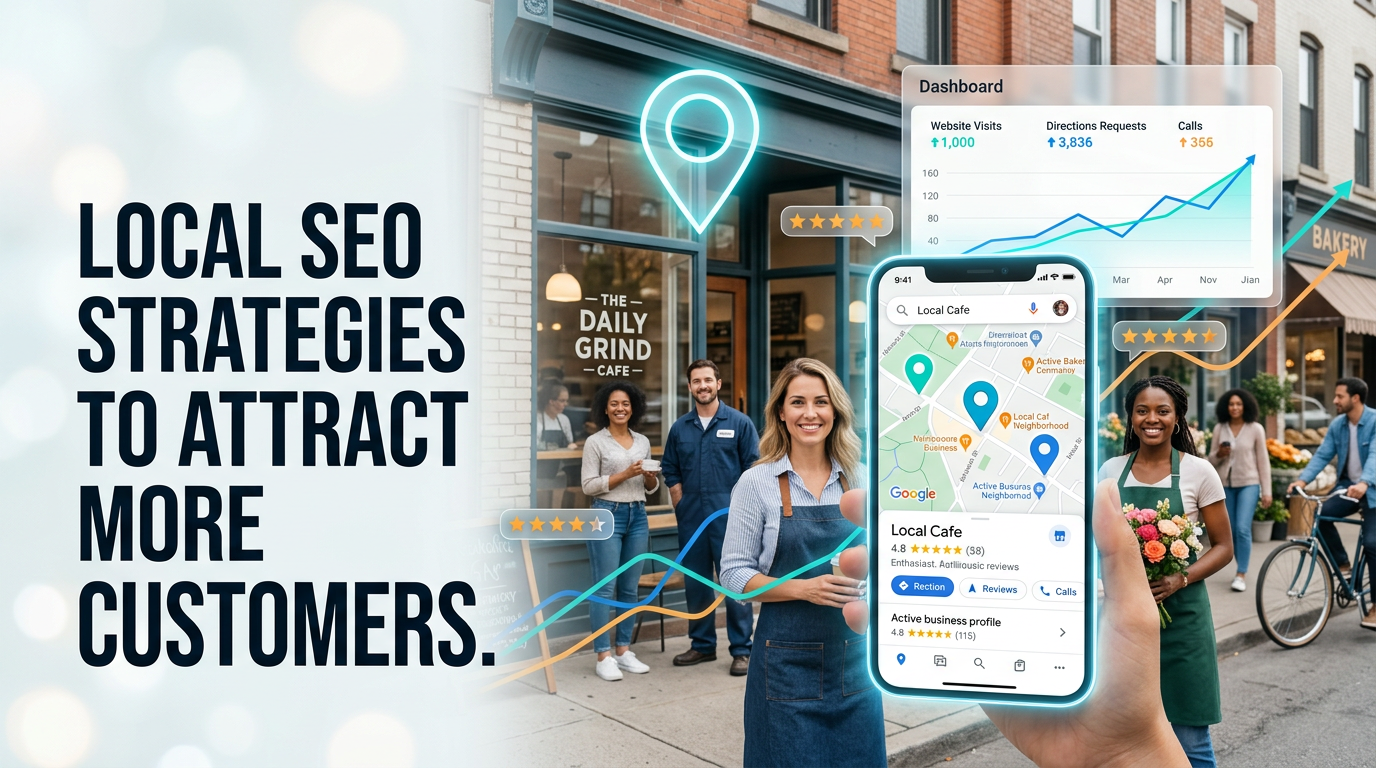
Most customers start their search for local products or services online. If your business is not showing up when they look, you are missing out on high-intent leads right in your backyard. Local SEO is what puts your business in front of people who are ready to buy, right when they are searching in your area.
A strong local search presence does more than boost rankings. It drives real actions: website visits, phone calls, direction requests, and walk-ins. That is why the next step is to make it effortless for local customers to find you, trust you, and choose you over the competition.
What Is Local SEO?
Local SEO means optimizing your website and online presence so you show up for searches tied to your location. Think about the way real customers search when they need something nearby:
- “Coffee shop near me”
- “Plumber in [city]”
- “Best accountant in [town]”
- “Marketing agency near [location]”
Local SEO is not about casting the widest net. It is about connecting with people who are actively searching for your services in your area. To make getting started easier, begin with your Google Business Profile and consistent listings. Then focus on collecting customer reviews and making sure your website clearly explains what you do and where you serve. As momentum builds, add local content and community partnerships. This means optimizing your website, managing your business listings, earning customer reviews, publishing local content, and building real visibility in your community.[2][9]
Optimize Your Google Business Profile
Your Google Business Profile is your digital storefront for local search. It is often the first thing people see when they look for businesses like yours on Google Search or Maps. If your profile is incomplete or outdated, you are leaving opportunities on the table.
Make sure your profile includes:
- Accurate business name, address, phone number, website, and hours
- The most relevant primary and secondary business categories
- A clear, keyword-aware business description
- High-quality photos of your team, location, products, or work
- Current holiday hours and service details
- Regular posts, updates, and responses to customer questions
Complete and accurate information helps search engines understand what your business does and where you serve customers.[3][2]
Keep Business Information Consistent
Consistency is non-negotiable. Your business name, address, and phone number need to match everywhere: your website, Google Business Profile, social media, local directories, and industry listings. Even small mismatches can hurt your visibility and confuse both customers and search engines. Keeping your information aligned across these places strengthens your local presence.
Focus on keeping your NAP information consistent:
- Name
- Address
- Phone number
Even small differences, such as “St.” on one listing and “Street” on another, can create confusion. To quickly check your business listings, search your business name on Google and review the top results to spot and correct any inconsistencies. Set a simple monthly reminder to scan these listings and update details immediately if your address, phone number, hours, or website changes.[10][3]
Use Local Keywords Naturally
Local keywords bridge the gap between your website and the customers searching nearby. Start by listening to how real people describe their needs and location; these are the phrases that matter.
For example, a bakery in Chaumont might target phrases such as:
- “Custom cakes in Chaumont, NY”
- “Birthday cakes near Watertown”
- “Local bakery in Jefferson County”
- “Wedding cake baker near me”
Use these phrases naturally in page titles, service-page copy, image descriptions, meta descriptions, blog posts, and related page content. Avoid cramming city names into every sentence; keep the content useful and easy to read.
Create Location-Focused Website Pages
If your business covers more than one city or neighborhood, build dedicated pages for each key area. Each page should offer unique, helpful information, not just a copy-paste with a different city name.
A useful local service page can include:
- The services you provide in that area
- Local customer needs or common questions
- Testimonials from customers in the region
- Directions, service boundaries, or nearby landmarks
- A clear contact form, phone number, or booking link
Location pages help search engines understand where you work while giving customers a faster path to the information they need.[5][10]
Ask for and Respond to Reviews
Reviews influence how potential customers view your business. They also provide fresh, customer-generated information about your products, services, and experience.
Create a simple process for requesting reviews after a successful purchase, completed project, appointment, or service visit. You can ask in person, include a review link in a follow-up email, or add a short request to a receipt or thank-you message. Most customers are happy to share feedback when you ask politely and show appreciation. You might say something like, “Thank you for choosing us! If you have a moment, we would really appreciate your feedback. Your review helps other local customers find us and supports our business.”
Always respond professionally to reviews:
- Thank customers for positive feedback
- Address concerns calmly and respectfully.
- Avoid arguing or sharing private details.
- Offer to resolve issues offline when appropriate.
Authentic reviews and thoughtful responses show prospective customers that your business is active, accountable, and customer-focused.[2][10]
Publish Local Content
Your website should address the real questions your local customers are asking. When you publish content that is genuinely relevant to your area, you give search engines more context and give people a reason to visit and share your site. To stay consistent, aim to publish new local content at least once a month. This keeps your site fresh and makes the schedule easier to maintain without feeling overwhelmed.
Consider creating content around:
- Local events and seasonal activities
- Community partnerships and sponsorships
- Area guides and helpful resources
- Frequently asked questions from local customers.
- Seasonal services, products, or buying tips
- Behind-the-scenes features about your business in the community
For example, a landscaping company could publish “How to Prepare Your Jefferson County Lawn for Winter,” while a bookstore could create “Holiday Gift Ideas for Readers in Northern New York.” Local content works best when it is genuinely useful, not when it simply adds a city name to a generic topic.[1][4]
Build Local Links and Partnerships
Links from trusted local websites do more than boost your SEO; they put your business in front of new audiences and build real credibility. Start by looking for ways to get involved in your community, both online and offline.
Potential local link opportunities include:
- Local chambers of commerce
- Business associations
- Community events and nonprofit sponsorships
- Local newspapers and online publications
- Schools, teams, and fundraising events
- Complementary local businesses
- Area resource guides and directories
Prioritize relationships and relevance. One link from a respected local organization can be worth far more than dozens of generic directory listings.[5][10]
Make Your Website Mobile-Friendly
Most local searches happen on a phone, often by people who are ready to take action. Your website needs to load fast and put the most important information front and center. Make sure mobile visitors can quickly find what they need.
Check that mobile visitors can easily:
- Click your phone number to call.
- Find your address and service area.
- Access directions
- Read your services and pricing information.
- Complete a contact form or booking request.
- View your hours and availability.
A clean, mobile-friendly site removes barriers and turns search visibility into real customer action.[8][10]
Track What Drives Results
Local SEO is not just about where you rank. What matters most are the actions that drive real business growth. With that in mind, review performance monthly and track:
Review performance monthly and track:
- Google Business Profile views
- Website visits from local search
- Calls, direction requests, and messages
- Form submissions and appointment bookings
- Review quantity and average rating.
- Keyword visibility for important services and locations
- Sales or leads generated from local search
Use these insights to spot which services, locations, and content are driving the most interest. Free tools like Google Business Profile Insights and Google Analytics make it easy to track where customers come from and how they interact with your business online. Even a quick monthly review of these tools can help you make smart decisions and double down on what is already working.
Start With the Basics
Once the basics are in place, add local content, service area pages, community partnerships, and a steady review process. These steps help make your business easier to find and easier for local customers to choose.[9][3]
Keep the basics in place, then build on them over time. Add local content, service area pages, community partnerships, and a steady review process to make your business easier to find and easier for local customers to choose.[9][3]
Sources
[1] Blogging for Local Search Results – Mailchimp
[2] How to Create a Local SEO Strategy That Attracts Customers to Your …
[3] 5 Local SEO Strategies Every Small Business Should Use
[4] Why Local SEO Is Important for Multi-Location Businesses – Uberall
[5] 20 local SEO strategies that made a difference – GoDaddy Blog
[6] How to Get More Local Traffic with Your Blog
[7] Local SEO: Tips & Strategies to Get Discovered– InMoment
[8] How to Make a Local SEO Strategy to Boost Local Visibility – Coursera
[9]Local SEO for Small Business Guide for 2026 | SeoProfy
[10] How to Do Local SEO for Small Businesses (Best Practices …
No responses yet